How MSPs Can Package and Sell Microsoft AI Services
Turning AI curiosity into an offer your SMB clients will actually buy



A client calls and says, “We need to do something with AI.” You ask what. Silence. They do not actually know. They just know everyone else seems to be doing it, they are not, and that gap is starting to feel expensive.
You have had this call. And here is the trap most MSPs walk straight into.
They answer with a tool. “We can set up Copilot.” “We can deploy agents.” Now the client is comparing your price to a YouTube tutorial, and you have turned a trust conversation into a shopping trip.
The question your offer should answer is not “what tool do you want.” It is this:
Where can AI save your team time without creating new risk?
Build everything around that one sentence and the whole conversation changes.
Same technology, three different starting points
Picture three of your clients. A small law office. A 40-person construction firm. A 120-person nonprofit. All three are interested in AI. None of them need the same first step.
The lawyer is terrified of confidential client data going somewhere it should not. The construction firm wants field notes turned into client updates without burning a Saturday. The nonprofit wants board summaries done in twenty minutes instead of three hours.
Microsoft 365 Copilot works across Word, Excel, Outlook, Teams, and more, but Microsoft says the experience varies by licensing and tenant configuration. That variation is exactly why you cannot hand every client the same “we turn on AI” package.
They do not need a switch flipped. They need someone to translate product complexity into business clarity. And here is the part a generic AI consultant cannot do. They do not know your client’s environment. You do. That context is your edge. Do not waste it.

What clients are actually struggling with
Nobody walks in asking for the future of work. They walk in tired.
They are rewriting the same emails. Summarizing the same meetings. Answering the same internal question for the fifth time this week. Searching for a document somebody swears exists.
That friction is where Microsoft AI earns its keep. But useful does not happen by accident. A Copilot license does not build better habits. A demo does not change a workflow. And an agent does not fix a business that keeps its knowledge in one employee’s head and a folder called “Final_FINAL_v3.”
The MSP who wins packages AI into safe, simple, repeatable steps. Start with the business problem. Pick the path that fits. Train the team. Then, and only then, decide if a deeper conversation makes sense. That sequence protects the client. It also protects you.

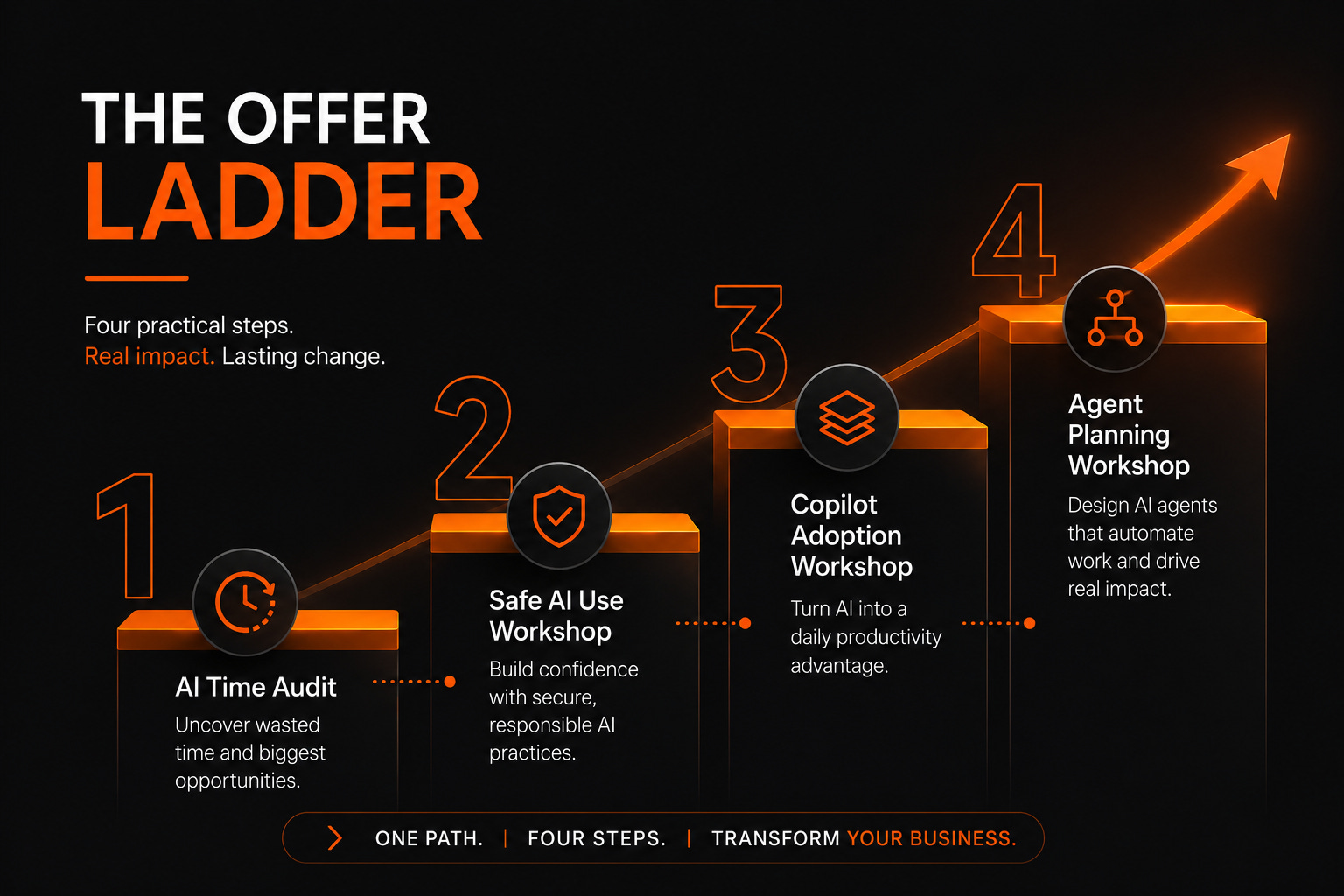
The offer ladder: four rungs, in order
Think of these like a ladder. Nobody jumps to rung four when they have not climbed rung one.
Rung 1, the AI Time Audit. Your entry offer. You are not implementing anything. You run a guided session that shows leadership where AI gives back real hours. Easiest thing on this list to sell, because every owner already feels time bleeding out of their week. You are not selling a tool. You are selling Saturdays back.
Rung 2, the Safe AI Use Workshop. The most overlooked offer here, and the one that builds the most trust. Your client’s people are already using AI tools. Leadership just does not know which ones, or what data is going into them.
Rung 3, the Copilot Adoption Workshop. Not a feature tour. Role-based practice where people work on their actual jobs with Copilot in the room.
Rung 4, the Agent Planning Workshop. The one everyone wants to start with and almost nobody is ready for.
Let’s walk the two that matter most, then I will give you the actual agenda for rung one.
Rung 1 in detail, plus the agenda I use
Time is the best thing to build your first offer around. Every owner understands it. Ask these five questions and watch the room lean in:
Where does your team repeat the same explanation every week? Which meetings create the most follow-up work? Where do people search too long for information? Which documents get recreated from scratch over and over? What work would you delegate tomorrow if you trusted the first draft?
Those questions pull the conversation off the clouds and onto the calendar.
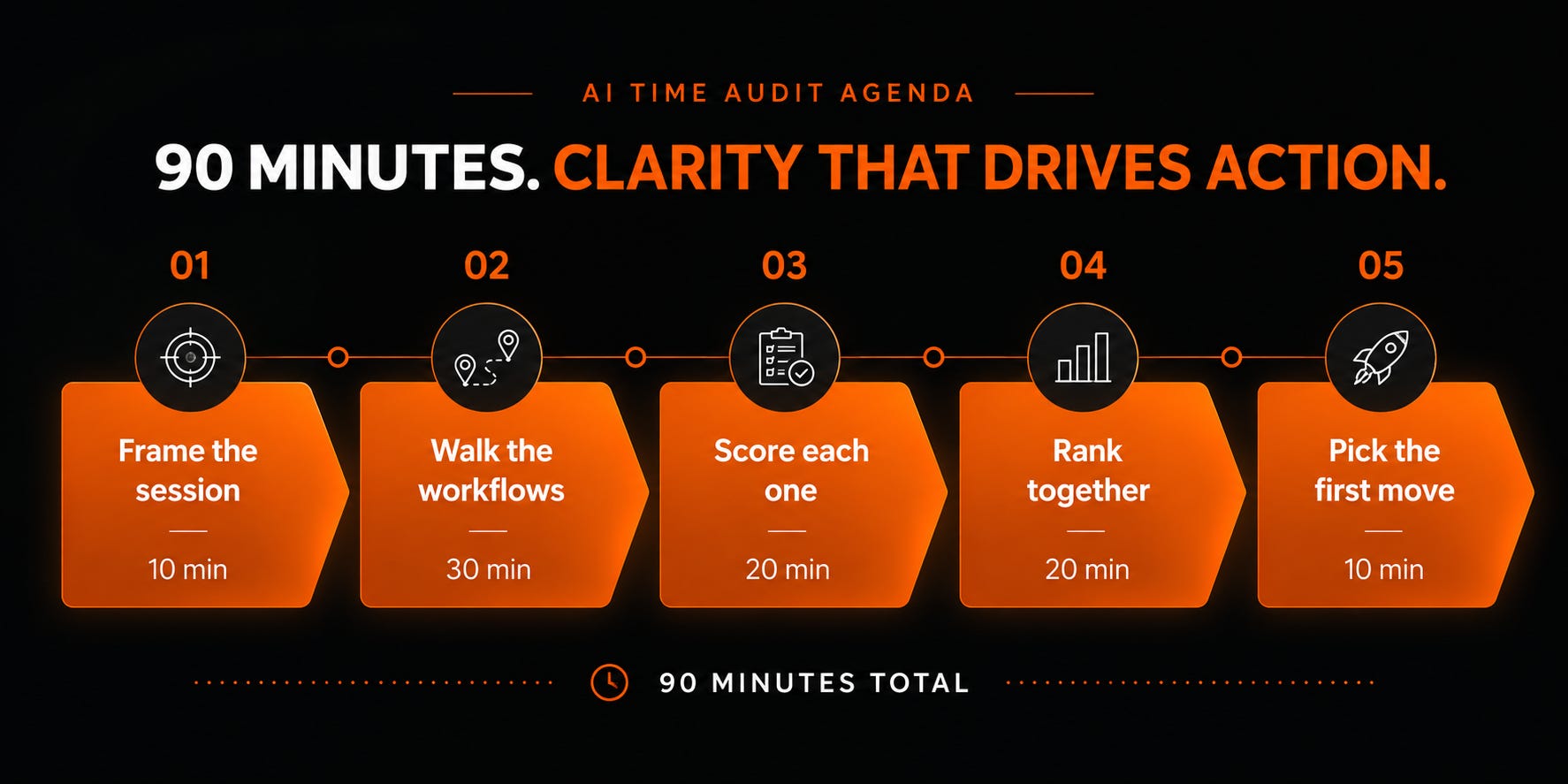
Here is the agenda, so you are not guessing. A 90-minute AI Time Audit runs like this. Ten minutes to frame the session and set the boundary that you are finding opportunities, not building anything today. Thirty minutes walking the team through their real weekly workflows using the five questions above. Twenty minutes scoring each one. Twenty minutes ranking the top opportunities together. Ten minutes agreeing on a single recommended first move.
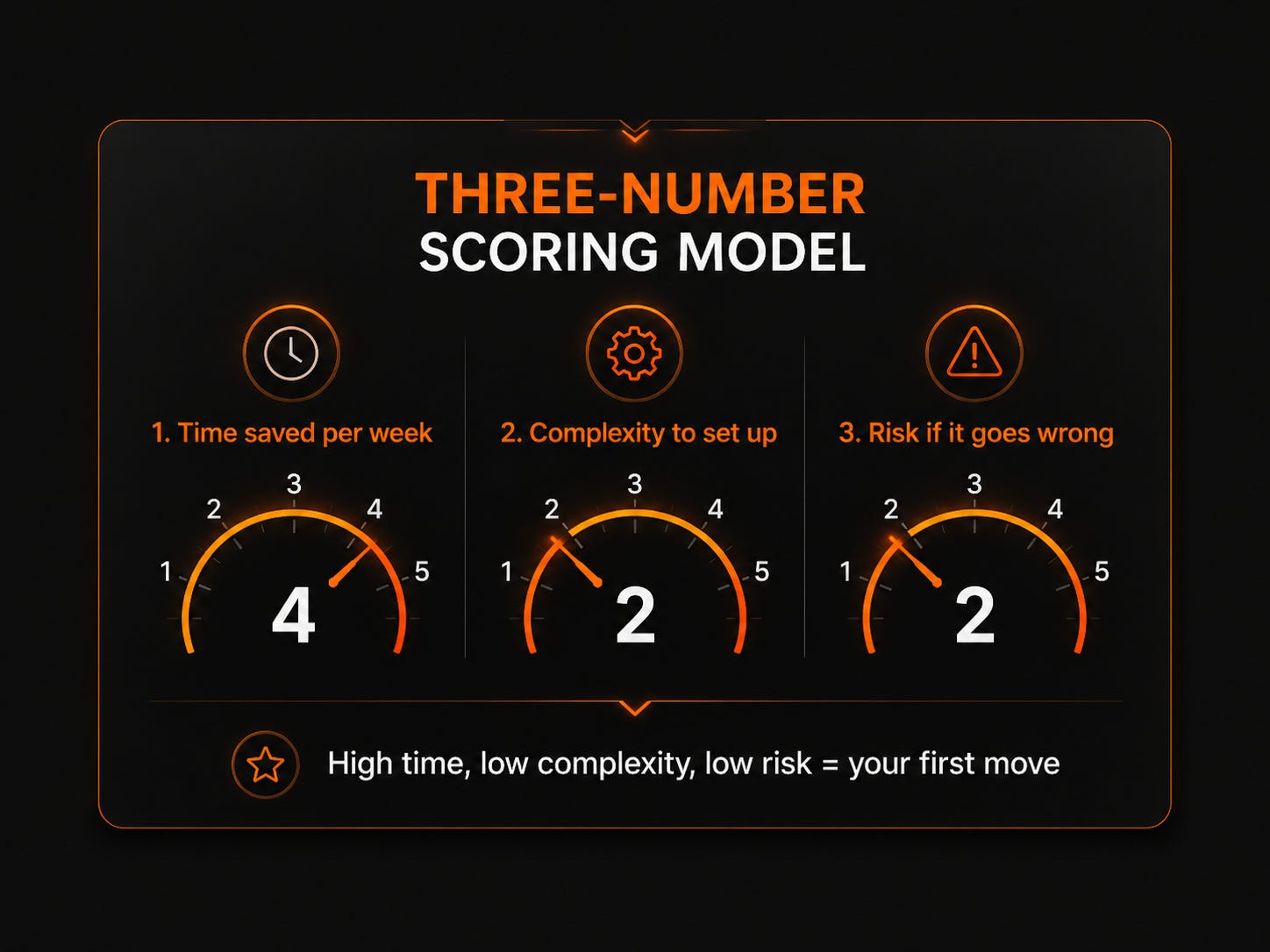
The scoring model is three numbers, one to five each. Time saved per week. Complexity to set up. Risk if it goes wrong. A workflow that scores high on time, low on complexity, and low on risk is your first move. A workflow that scores high on time but high on risk goes into the “later, with guardrails” pile. That is the entire model. It fits on an index card, and that simplicity is the point.
The deliverable is a short written summary the client can share with leadership. A ranked list, the scores, and one recommended next step. Beginning, middle, end. The deliverable is clarity, not implementation, which keeps scope creep from eating your margin.
And notice the name. “AI Time Audit” sells. “AI consulting” makes a client nervous about an open-ended invoice.
Rung 2, the workshop that names the quiet fear
Your client’s people are experimenting right now. The question is whether they are doing it carefully. Microsoft does provide enterprise data protection for prompts and responses in Microsoft 365 Copilot and Copilot Chat, for users signed in with a Microsoft Entra account, under its commercial data protection commitments. Useful. Not the same thing as your client’s team knowing what is safe to type.
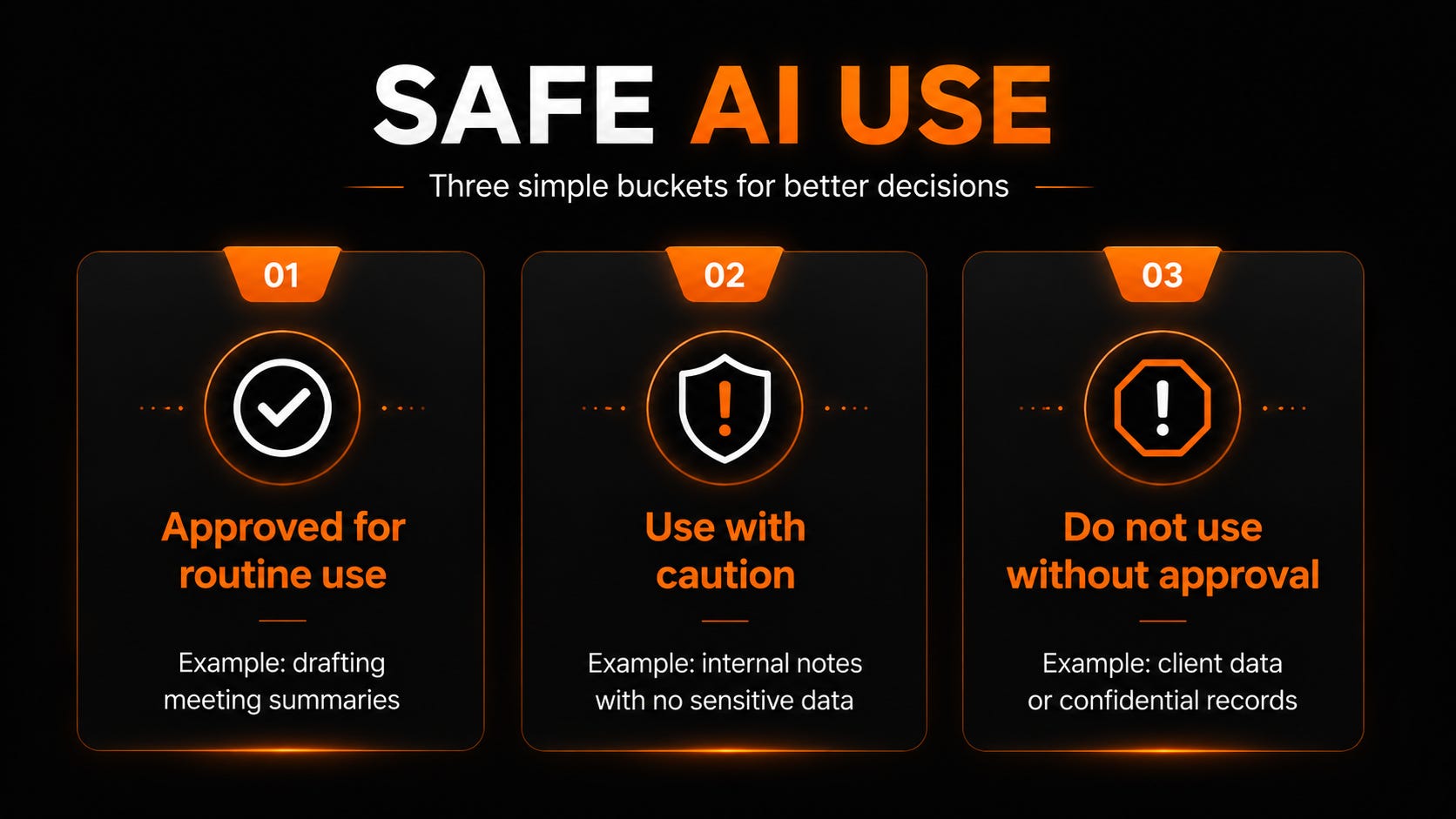
So you give them a framework a busy owner can remember. Three buckets. Approved for routine use. Use with caution. Do not use without approval. A public marketing draft is routine. A client contract, an HR matter, regulated data, confidential financials are caution or formal review. The exact rules depend on the client’s business, and you are not their lawyer, so you do not pretend to be.
The value is not that you answer every legal question. It is that you help the client stop pretending AI use is not already happening, and then build safer habits.
A quick honest note, because not every session is a win
I will be straight with you, because the people selling you AI magic will not be. The first time I ran a version of the adoption workshop, I put executives, salespeople, and operations staff in one room with one set of examples. It flopped. The execs were bored, the ops team was lost, and nobody walked out with something they could use Monday.
That failure is where the role-based rule came from. Now the adoption workshop is built around the actual job. Executives practice meeting summaries and updates. Sales practices follow-ups and account notes. Operations practices checklists and handoffs. Same tool, four different sessions, four times the value.
And sometimes the honest finding is that a client is not ready at all. I have told an MSP’s client that step one was not an agent, it was cleaning up their scattered knowledge first. They did not buy the build. They came back two quarters later and bought three engagements, because I told them the truth instead of selling them the thing that would have failed. That is the whole game.
The sales conversation, simplified
Four moves. Lead with pain. Connect pain to a workflow. Offer a safe first step. Recommend the next action.
It sounds like this. “Based on what you shared, I would not start with a full AI rollout. I would start with an AI Time Audit for your operations and client service workflows. You will walk out with a short list of practical use cases, the risk notes, and a recommended path. From there we decide together what is worth building.”
Easier to approve than a vague transformation project. And it positions you as the advisor, not the vendor. Advisors get hired again.
When a client pushes back with “just build me the agent,” you do not argue. You say, “Happy to, and the fastest way to a good agent is one planning session first so we do not build the wrong thing. One page, clear scope, then we build.” You are not declining the work. You are sequencing it so it succeeds.

Make it repeatable or it does not scale
If only one person in your company can explain, sell, and deliver AI, you do not have an offer. You have a bottleneck wearing a tie.
Build a delivery kit for every package. Sales one-pager, discovery questions, intake form, workshop agenda, client worksheet, follow-up email, final deliverable template. Then run a short feedback loop after every delivery. What confused the client? Which example landed? What follow-up offer made sense?
That loop turns your offer into an asset that gets sharper every quarter, instead of a performance you repeat from scratch.

Where to start
You do not need to be the loudest AI voice in your market. You need to be the most trusted guide for clients who just need to know what to do this month.
Start with where time is leaking. Add safe use guidance. Train people in the tools they already touch. Plan agents only when the case is real. Then do it again with the next client.
Start with one offer. Name it clearly. Build the workshop. Sell the outcome. Repeat.
You now have the Time Audit agenda and the scoring model. That is enough to run your first one this month. If you would rather build the full ladder with someone who has run it, book the Tech Simplified MSP AI Offer Builder (starting at $1,500) and walk away with a named, positioned, workshop-ready AI offer for your SMB clients.
Always Be Learning.
Tech Simplified is an independent business and is not affiliated with, endorsed by, or representing Microsoft. Sly Gittens works at Microsoft in a separate capacity.