
Microsoft 365 E7 for Business Owners: What It Is, Where It Fits, and How to Compare It with E5
A practical guide to understanding Microsoft 365 E7, comparing it with E5, and deciding whether the added AI, security, and identity capabilities are worth the investment for your business.


Your business does not need another confusing license conversation. It needs a clear answer on whether Microsoft 365 E7 can improve security, productivity, and AI adoption in a way that actually helps the business run better.
Why Microsoft 365 E7 Is Getting Attention
Microsoft is not presenting E7 as just another step above E5. It is presenting E7 as part of a broader shift it calls Frontier Transformation, where employees and AI agents work together across the business in a more structured, more governed, and more operational way.
That framing matters.
For many owners and executives, AI has felt like a mix of promise and chaos. Teams want to use it. Managers want faster output. Leadership wants the upside. But at the same time, there are real concerns about data exposure, inconsistent permissions, unmanaged prompts, and tools being adopted faster than policy.
Microsoft’s answer is built around two ideas: intelligence and trust.
Intelligence means AI should understand the real context of work, not just generate generic output from a prompt.
Trust means AI should operate within the same identity, security, governance, and compliance boundaries your business already depends on.
That is the real E7 story. It is not only about “more features.” It is about packaging productivity, AI, identity, and security into one business platform designed for organizations that want to move beyond AI experiments.
What Microsoft 365 E7 Actually Includes
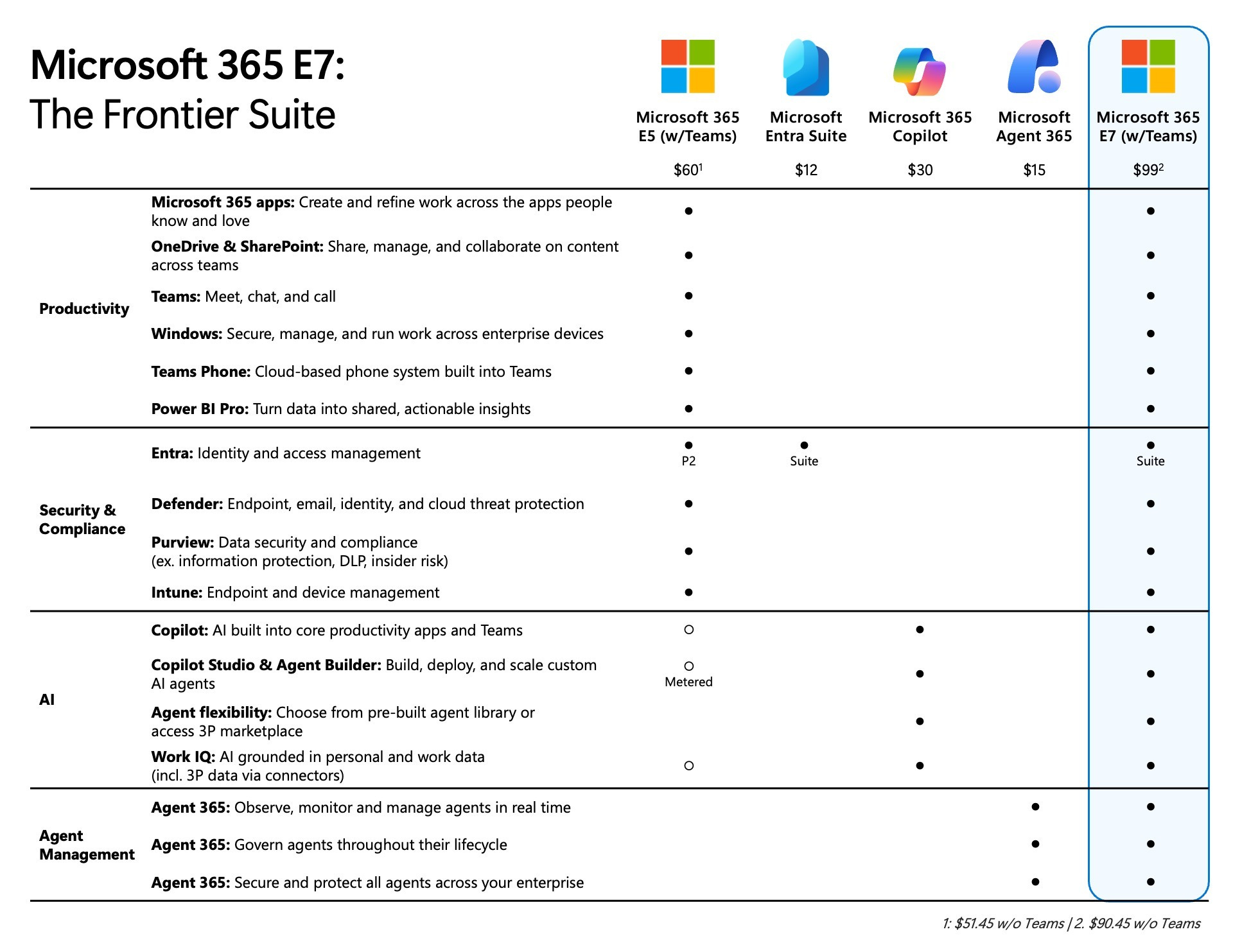
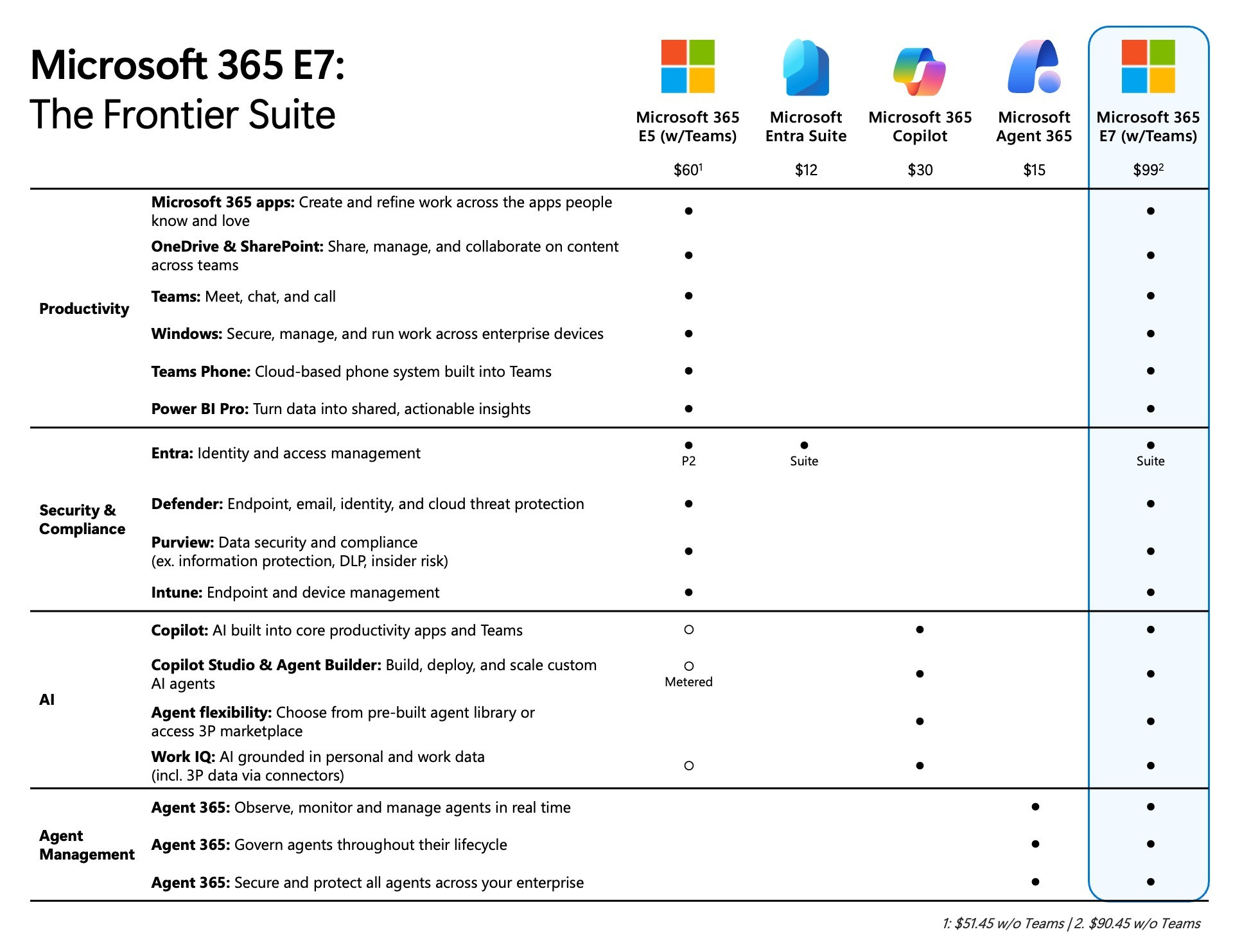
At a practical level, Microsoft 365 E7 includes:
Microsoft 365 E5
Microsoft 365 Copilot
Agent 365
Microsoft Entra Suite
That means E7 takes the strong enterprise foundation of E5 and layers on Microsoft’s newer AI and agent-management strategy.
For a business owner, it helps to think of it like this:
E5 gives you a premium Microsoft enterprise foundation.
E7 is Microsoft’s push toward AI-enabled operations on top of that foundation.
This is an important distinction. If E5 is about giving your organization advanced productivity, security, compliance, and identity controls, E7 is about helping the organization use those controls while scaling AI and agents across daily work.
The Core Idea Behind E7: Intelligence Plus Trust
Microsoft’s current messaging is centered on a simple business truth: AI becomes valuable only when it is both useful and governable.
That is where the “intelligence and trust” message comes in.
Intelligence in this context means Copilot and agents can work with the context of your files, meetings, chats, relationships, and business workflows.
Trust means those capabilities are protected through identity, permissions, policies, observability, compliance controls, and security tooling.
For business leaders, this is a useful lens because it shifts the licensing question away from feature shopping.
The better question becomes: Do we need AI that merely helps users, or do we need AI that can participate in work across the organization under governance?
That is a more executive-level question. It focuses on operating model, not just software.
Why Microsoft Calls This “Frontier Transformation”
Microsoft uses the term Frontier Transformation to describe a move from AI experimentation into durable business change.
That language is important because it tells you how Microsoft wants E7 to be understood.
This is not just about asking an AI to write an email faster. It is about building an environment where:
people use AI inside the tools they already know
AI can carry out multi-step work
business leaders can observe what AI is doing
IT and security teams can govern AI at scale
organizations can standardize how AI shows up across work
For very large enterprises, this is an easier story to justify because they already have scale, complexity, and fragmented systems.
For SMBs, the value depends on whether the business is starting to feel enterprise-like pressure even at a smaller size.
That can happen sooner than owners expect.
A 40-person company with client-sensitive data, hybrid work, growing automation needs, and multiple departments may feel more operational complexity than a much larger business with simpler processes.
That is why headcount alone should not decide whether E7 is relevant.
Wave 3 of Microsoft 365 Copilot: Why It Matters in the E7 Conversation
A major part of Microsoft’s E7 story is tied to what it calls Wave 3 of Microsoft 365 Copilot.
This matters because Microsoft is moving Copilot from a basic assistant model toward more agentic, embedded, and workflow-aware behavior.
In plain language, Copilot is no longer being pitched as just a prompt box that writes text on demand. Microsoft is positioning it as something that can work more naturally inside business applications and carry work forward in a more useful way.
For executives, this changes the value discussion.
Earlier AI conversations often sounded like this:
Can AI summarize meetings?
Can it write drafts?
Can it answer questions?
Wave 3 pushes the conversation further:
Can AI refine the work already happening in our apps?
Can AI act from chat?
Can AI carry out multi-step tasks?
Can we give users more value without losing governance?
That is one reason E7 feels more strategic than a normal Microsoft 365 license tier.
Copilot Inside Word, Excel, PowerPoint, and Outlook
One of the most practical additions in Microsoft’s current messaging is that Copilot is working more deeply inside familiar Microsoft 365 apps.
That sounds simple, but it is a major part of the business value story.
Instead of treating AI as a separate place users visit, Microsoft is pushing app-native experiences where Copilot works alongside the user inside the tools where the work is already happening.
Examples Microsoft highlights include:
refining a Word document into a polished draft
improving Excel spreadsheets with real formulas
building PowerPoint slides that fit the organization’s layout and brand style
drafting and refining emails directly in Outlook
For business owners, this matters because adoption usually improves when people do not need to leave their normal workflow.
A sales manager does not want to jump through five tools to improve a proposal.
An operations lead does not want AI to create a disconnected file that has to be copied around manually.
A team leader wants help inside the tool they are already using.
That app-native model is one of the strongest practical selling points in Microsoft’s broader E7 and Copilot story.
Copilot Chat as the Starting Point for Action
Microsoft is also emphasizing chat-first work in a bigger way.
That means Copilot Chat is not only a place to ask questions. It becomes an entry point for creating and moving work forward.
Microsoft’s examples include creating:
documents from chat
spreadsheets from chat
presentations from chat
scheduling actions from chat
drafting and sending emails from chat
That may sound like a convenience feature, but it has business importance.
Why?
Because user adoption often depends on simplicity.
If employees can start from a conversation and then move directly into documents, spreadsheets, presentations, and actions, the AI experience becomes easier to use and easier to picture in daily work.
For an SMB leader, this is where the value becomes more tangible. You can imagine a manager using chat to kick off work instead of switching among multiple tools and losing momentum.
Copilot Cowork: AI That Handles Multi-Step Work Over Time
One of the biggest pieces many business summaries miss is Copilot Cowork.
This is Microsoft’s move toward AI that can handle longer-running, multi-step work rather than only answering single prompts.
That distinction matters a lot.
Traditional AI use often looks like this:
summarize this meeting
write this email
rewrite this paragraph
create a short draft
Copilot Cowork points toward something more operational:
break a complex request into steps
reason across tools and files
carry work forward over time
show visible progress
allow the human to guide, review, or stop the work
For business owners, the value is obvious when you think about repetitive knowledge work.
Imagine a leadership assistant role, an operations coordinator role, or a sales support function. Much of the work is not a single action. It is a chain of actions.
That is where multi-step AI can become more meaningful than simple content generation.
Just as important, Microsoft emphasizes that this work should remain observable and reviewable.
That is a critical executive concern. Leaders rarely object to AI because it is fast. They object when it becomes unclear, unmanaged, or difficult to control.
Work IQ: Why Context Matters More Than Clever Output
Microsoft also uses the term Work IQ in its current Copilot messaging.
The idea is straightforward: AI becomes more valuable when it understands the broader context of work, not just one isolated prompt.
That context can include:
files
chats
meetings
relationships
work history
current business materials
For an executive, this matters because generic AI output is not enough. Businesses need output that reflects what is actually happening in the organization.
A draft proposal should use the right source material.
A meeting summary should reflect actual context.
A presentation should align with what the company is already doing.
A follow-up email should be grounded in real conversations and real priorities.
That is the promise of context-rich AI. And Microsoft is making that a central part of its value story for Copilot and E7.
Multi-Model Intelligence: Why Microsoft Is Emphasizing Flexibility
Another new part of Microsoft’s message is multi-model intelligence.
Instead of locking users into one model vendor, Microsoft is presenting Copilot as a work experience that can use leading models from multiple providers, applying the right model for the task while keeping the experience inside Microsoft’s governance and security framework.
For many SMBs, this will not be the first reason to buy E7. Most owners are not looking to manage model strategy directly.
But it still matters for two reasons.
First, it supports Microsoft’s claim that Copilot is intended to evolve with the AI market rather than remain tied to one underlying model approach.
Second, it reduces the pressure on employees and managers to choose among disconnected tools. The more Microsoft can keep model complexity behind the scenes, the easier adoption becomes for the business.
For executives, this translates to a simpler message: Microsoft wants to be the governed front door for workplace AI, even as the model ecosystem changes.
Agent 365: The Control Plane for Agents
One of the most important additions in E7 is Agent 365.
Microsoft describes Agent 365 as the control plane for agents.
A control plane is the central place used to observe, manage, secure, and govern systems.
This is a major idea because it changes the conversation from “our people are using AI” to “our organization is operating AI agents.”
That is a very different level of maturity.
Agent 365 is designed to give IT and security teams one place to manage agents across the organization, rather than treating each AI workflow as a separate experiment.
For executives, the business value shows up in a few ways:
better visibility into how agents are used
less unmanaged AI sprawl
more consistent security and governance
easier scaling from pilots to standard operations
This is one of the clearest differences between a normal productivity story and the broader E7 story.
If your company is only looking for AI drafting support, Agent 365 may be more than you need.
If your company wants to run AI-supported workflows across teams, Agent 365 becomes far more relevant.
Observability, Transparency, and Why Leaders Care
Microsoft repeatedly emphasizes that agentic and Copilot-driven work should be:
observable
transparent
reviewable
reversible
stoppable
This is one of the strongest practical points in Microsoft’s story, and one of the most important for business owners.
Automation is not enough.
Leaders need to know:
what the AI is doing
what data it can access
what actions it is taking
who can review the output
whether the process can be interrupted or changed
That is what makes the concept of trust real.
For SMB leaders, this can actually be more important than the AI features themselves. Small businesses often do not have the time or staff to manage hidden complexity. They need tools that support action and make that action visible.
Existing Permissions, Sensitivity Labels, and Data Protection
One of the most reassuring parts of Microsoft’s message is that Copilot is designed to work within existing Microsoft 365 protections.
That includes:
existing permissions
sensitivity labels
OneDrive and SharePoint storage patterns
governance controls
audit policies
retention and compliance alignment
This is a major point executives should understand.
A common fear is that AI will become a shortcut around existing data controls. Microsoft’s message is the opposite. It is arguing that workplace AI should inherit and respect the rules the organization already uses.
For a business owner, that matters because it means AI can potentially be introduced in a way that supports existing governance rather than replacing it.
Of course, that only helps if the existing governance is actually in good shape.
If your permissions are messy, your labels are inconsistent, and your access model is weak, AI may simply expose those weaknesses faster.
That is why E7 should also be viewed as a readiness question, not just a licensing question.
Agent Builder and Copilot Studio: Building, Not Just Using, Agents
Another area worth calling out is that Microsoft is not only talking about using agents. It is also talking about how organizations can create them.
The blog distinguishes between:
Agent Builder for simpler day-to-day agents
Copilot Studio for more advanced business process agents
That matters because it shows Microsoft sees AI value in two layers:
employees using AI in everyday work
the business designing AI-assisted workflows intentionally
For SMBs, this distinction is useful.
A smaller company may start with simpler agent creation to support everyday work.
A more mature or fast-growing business may use Copilot Studio-style approaches to support onboarding, procurement, support processes, document handling, or other repeatable workflows.
This expands the E7 value story beyond user productivity. It turns E7 into part of an operating model discussion.
E7 for Small Business: When the Value Is Real
For small businesses, E7 is not automatically the right answer.
That is the most important truth to keep in view.
The best SMB use cases are usually businesses that are small in size but high in complexity, risk, or process demands.
Examples include businesses with:
sensitive client information
distributed or hybrid teams
growing compliance pressure
multiple systems and workflows
strong interest in governed AI use
a need to automate repeatable work without losing control
A five-person local business that mainly needs email, collaboration, and basic security will likely not see the full value of E7.
A 60-person professional services firm handling confidential documents, remote access, approvals, proposals, and internal process automation may.
That is why owners should not treat E7 as a prestige purchase. It is a fit decision.
The smartest SMB lens is this: Are we becoming operationally complex enough that governed AI, stronger identity, and agent management would create real business value?
E7 for Large Enterprises: Why the Business Case Is Easier
For large enterprises, the E7 story is easier to justify.
Large organizations already struggle with:
scale
tool sprawl
fragmented AI pilots
more complicated access control
bigger compliance and governance requirements
a higher cost of unmanaged AI
In that context, E7 aligns more naturally with how the business already operates.
Enterprises are more likely to need:
common standards for Copilot and agents
centralized visibility and governance
stronger identity and policy enforcement
a platform approach instead of piecemeal AI tooling
That is why Microsoft’s official language is aimed strongly at enterprise-scale transformation.
Still, SMB leaders should pay attention to the enterprise story because it shows where Microsoft believes work is heading. Even if E7 is not the right fit today, it may shape what “good” looks like for AI governance tomorrow.
E5 vs E7: A Simple Business Comparison
Here is a practical comparison table for owners and executives.
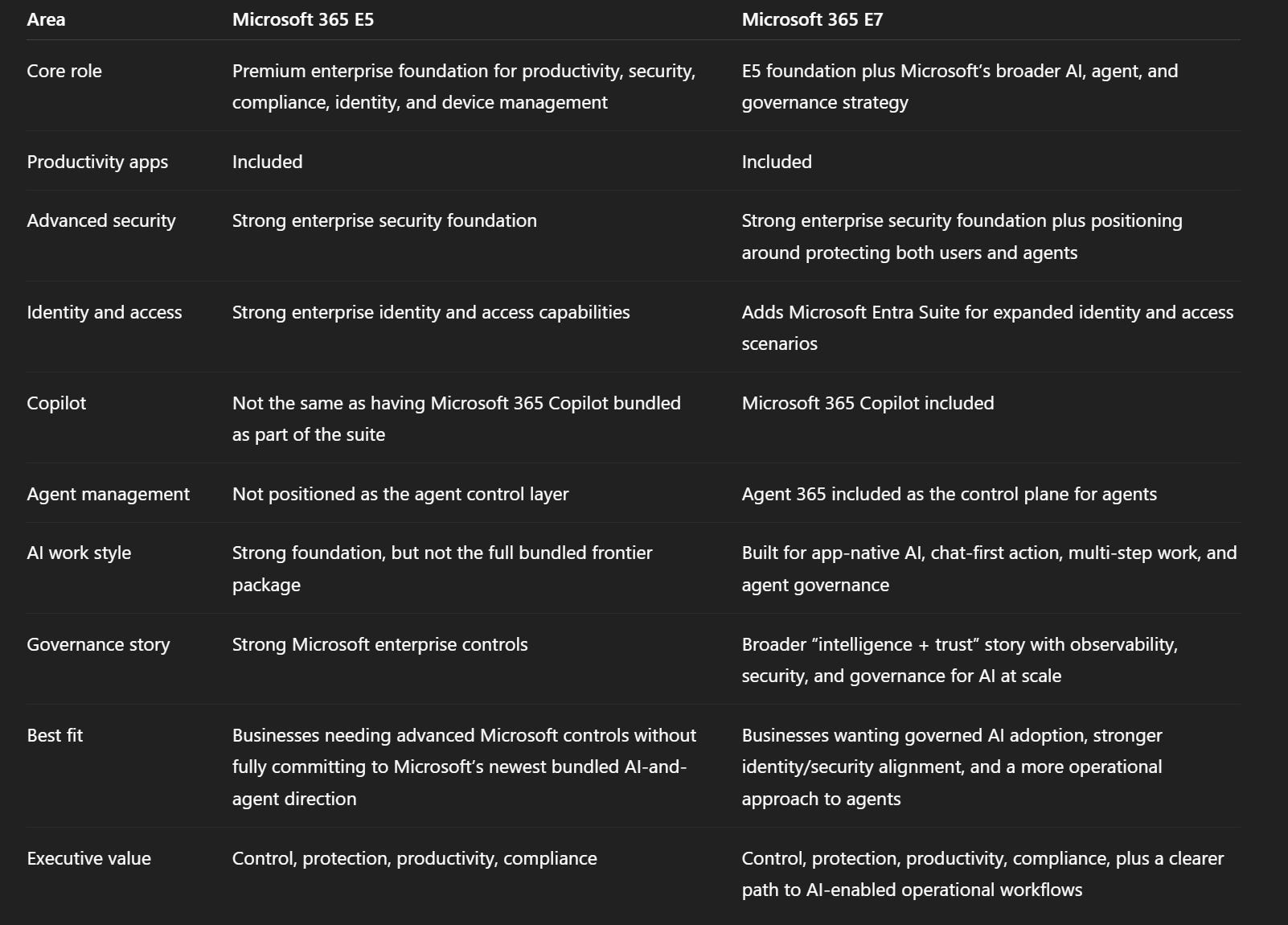
The simplest executive takeaway is this:
E5 is a powerful enterprise foundation. E7 is Microsoft’s bundled AI-and-agents expansion layer on top of that foundation.
A Realistic SMB Scenario
Imagine a 55-person business services firm.
The company has grown quickly. Staff work from home several days a week. Managers are already experimenting with AI in different ways. Proposal creation is inconsistent. Follow-up emails take too long. Meeting notes are scattered. Leadership also worries about confidential client data being copied into unmanaged tools.
At first, E5 looks like the right answer because the business still needs stronger security, identity, device control, and compliance habits.
That is a sensible starting point.
But now leadership wants more than protection. It wants AI to help carry work forward in a more organized way. The company wants users to work with Copilot inside documents, spreadsheets, presentations, and email. It wants better governance around AI use. It wants a future path for agents that can support repeatable business processes.
That is where E7 starts to look different.
The value is not just that it has “more.” The value is that it combines the productivity layer, AI layer, identity layer, and governance layer into one strategic package.
Would every 55-person business need that? No.
Would some 55-person businesses be exactly the kind of company that benefits from it? Absolutely.
What Business Owners Are Most Likely to Miss
The biggest mistake is thinking E7 is just E5 plus a few AI extras.
That undersells what Microsoft is actually trying to do.
Microsoft is packaging a future-of-work model where:
AI is embedded in the apps people already use
chat becomes a launch point for action
agents can do more than answer prompts
multi-step work can unfold over time
existing security and governance controls remain central
IT and security leaders can observe and govern what happens
That is a much bigger story than a feature checklist.
The second mistake is buying E7 before the business is ready.
Advanced licensing does not fix weak permissions, poor offboarding, unmanaged devices, inconsistent data classification, or unclear AI policy.
In some organizations, E7 will create real value.
In others, E5 or an even lower tier paired with better operational discipline may create far better ROI.
Why This Matters to SMB Operator Jordan
If you run or support a small-to-mid-size business, your real challenge is balancing risk, productivity, and simplicity.
You do not need technology that looks impressive in a licensing deck but creates confusion in daily operations.
You need tools that help the business become:
more secure
more reliable
more productive
easier to govern
more ready for the next stage of growth
That is why understanding E7 matters even if you do not buy it today.
It shows where Microsoft is heading: toward a model where AI, identity, security, governance, and productivity are no longer separate conversations.
For very small businesses, that future may still be farther away.
For growing SMBs, it may be arriving much faster than expected.
Microsoft 365 E7 is best understood as a business platform for organizations that want to move from AI experimentation toward governed, operational AI.
It builds on the strong E5 foundation and adds Microsoft’s newer strategy around Copilot, Agent 365, Entra Suite, app-native AI experiences, chat-first workflows, multi-step work, and governance built around observability and trust.
For large enterprises, that value is easier to justify right now.
For SMBs, the value becomes real when the business has enough complexity, enough risk, and enough automation ambition to use those capabilities well.
The smartest question is not, “Is E7 the most advanced license?”
The smartest question is, “Are we ready to use E7 in a way that improves how our business actually works?”